Curtiss P-40E, K, M, N Warhawk/Kittyhawk
- 297 aircraft (NZ3001-3293 + 4 aircraft destroyed before officially being brought on charge), 1942-1945.
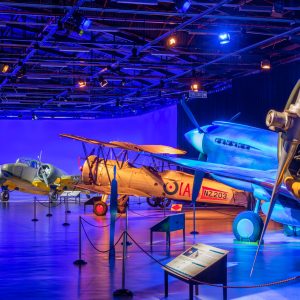
The P-40 Kittyhawk (Warhawk in U.S. service) was the backbone of RNZAF fighter squadrons from 1942 to the middle of 1944. Equipping eight squadrons and two training units, Kittyhawks of various marks were used to train fighter pilots at home in New Zealand and overseas, defensively and offensively, in the Solomon Island campaigns of World War Two.
44 Kittyhawk P-40Es were diverted from RAF orders and arrived in New Zealand in mid-1942 for pilot training. In October 1942, No. 15 Squadron went to Tonga and took over 23 second-hand P-40Es from the USAAF 68th Pursuit Group. These battle weary aircraft would later move to New Zealand in a training role. In 1943 new P-40Ks, Ms and Ns began arriving. The aircraft were ferried to the Islands and stayed on operations until mid-1944, when they were replaced by Vought/Goodyear Corsairs. The Kittyhawks returned to New Zealand in a training capacity. By War’s end there were only 124 Kittyhawks remaining, 20 having been lost in combat, 76 in accidents overseas and another 76 in accidents in New Zealand. The survivors were sold for scrap in 1948.
During their time at the front, RNZAF Kittyhawks accounted for 99 Japanese aircraft destroyed in air combat, with a further 14 probables.
History of Curtiss P-40F Warhawk 41-14205
The P-40 being restored was manufactured in Buffalo, New York, in 1941; it was the 606th of the 699 Rolls-Royce Merlin-powered, short fuselage, P-40Fs ever built. It originally served with the USAAF's 7th Air Force, 18th Fighter Group, 44th Fighter Squadron during the War. On 23 December 1942 it was part of a four aircraft gunnery training exercise, flying out of Efate airfield in the New Hebrides (now Vanuatu). The flight became disoriented during the exercise, and was forced to make an emergency landing on a cattle ranch on nearby Erromanga Island when they ran low on fuel. Two aircraft belly-landed successfully but 14205 and 14112 went off an embankment and were badly damaged. The pilot of 14205, 2Lt George ‘Ed’ Talbot was injured in the crash and was evacuated two days later. Two aircraft were salvaged but 14205 and 14112 were stripped of usable parts and abandoned where they lay. In 1989, both aircraft were recovered from the jungle on Erromanga by Robert Grienert and Ian Whitney, and taken to Australia for restoration. In 1996, 41-14205 was acquired by the Air Force Museum from Graham Hosking of Victoria, Australia, in exchange for a F4U-5N Corsair.
The Restoration
As the RNZAF never flew any of the Merlin-powered P-40Fs, it was decided to restore 41-14205 as an Allison V-1710 powered P-40E, as the ‘E’ was also a short fuselage variant and the two types are virtually identical except for the engine installation.
Some restoration had been carried out in Australia prior to its arrival in New Zealand. The Air Force Museum began its restoration in 1997, initially concentrating on the fuselage. Work on the badly damaged wings started in 2002 and both fuselage and wings are now nearing completion.
Much of the original structure of the aircraft has required replacing, as 48 years in the tropical climate had taken its toll on the aluminium airframe, not including the damage caused by the actual crash. Any replacement structure and parts are constructed using the correct materials and repair schemes applicable to this type of aircraft. The airframe will be fitted out to RNZAF P-40E standard and will be painted in a late-War scheme, to represent the various marks of Kittyhawk operated by the RNZAF.
If you believe that you may have any parts or information that would be useful to the restoration of the P-40E, please contact the Museum.